Featured Essays

Showing posts with label Internet. Show all posts

Sunday, July 3, 2011

What Is Google+? Introducing the New Evolution of Social Media


Big changes are coming to Google.

You may have noticed the many drastic changes to the Google interface over the past several weeks. First, there was the big striking black navigation bar on top of the screen. Then, the left sidebar menu changed its font, colour, size and iconography. This is followed by the integration of the "+1" button next to your search results, not to be mistaken with its evil counterpart: the "Block all results from this website" button. They even removed the popular RealTime Google search function, which previously retrieved live-time tweets from Twitter users. All these changes finally came together on June 28th 2011, when Google announced its launch of the Google+ platform.

What is Google+? The latest innovation from Google has been classified under many descriptions. It is most commonly hailed as the "new rival of Facebook" due to the prominent social media integration within the Google+ platform, where users can submit live-time news and share online content within their social communities. You are able to categorize online users into different communities, such as friends, family, business acquaintances, and other like-minded individuals, and communicate different kinds of information through these compartmentalized channels. Google+ places a heavy focus on creating, communicating, and sharing social content with online users – but not just with any ordinary Joe on the Internet; instead, Google connects you to a specialized community of users that has the same likes, interests, and online surfing habits as you do. In other words, imagine Google+ as a more intimate and customized level of social media.

With the launch of Google+, the biggest search engine in the world is about to get even bigger. This article will continue to explore the many changes that you can expect from this massive Google update, and how it might affect your online browsing experience.

Saturday, March 19, 2011

The Rebecca Black Story – A Commentary on the Pop Music Industry

The Rebecca Black Story – A Commentary on the Pop Music Industry

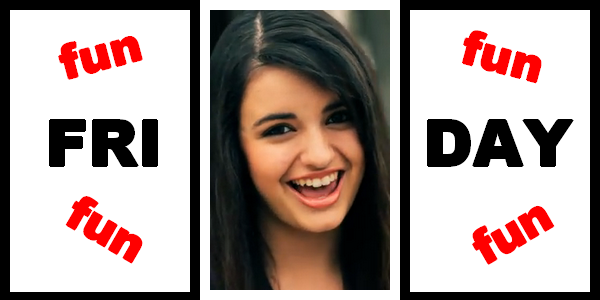
Rebecca Black became famous for all the wrong reasons.

In the age of social media, where unknown artists are constantly discovered online, it is easy for anyone to post a music video on Youtube, but much harder to get noticed among the many others vying for the same ambitions. How does one distinguish themselves from all the wannabe musicians on the Internet? The thirteen-year-old Rebecca Black may have discovered an unlikely answer. This week, she became an instant online sensation after her debut music video "Friday" launched on Youtube. In the span of seven days, she achieved over 20 million views on Youtube, broke top records on Twitter, and quickly climbing the sales charts on iTunes. It is quite a feat for somebody so young and so inexperienced within the music industry.

The reason why Rebecca became popular is not because she sings extraordinarily well. In fact, being the exact opposite has propelled her to infamy across the world. She was brought to public awareness after a comedic segment on Tosh 2.0, which described it as the worst song of all time. Indeed, there are numerous elements about "Friday" that culminated to a cringe worthy experience. Whether it is the nasally voice, the banal lyrics, or the awkward dancing, the majority opinion is overwhelmingly unfavourable. Yet, like a train wreck in motion, our pop culture remained fixated with this aspiring starlet. After a while, you may become accustomed or even enjoy the catchy beat of the terrible song!

The Rolling Stone offered an intriguing perspective on Rebecca Black's recent infamy. One writer believes this song is an unintentional parody on the music industry. "Friday", which is a song that literally describes the days of the week, epitomizes the banality of pop music nowadays. Anyone can put together a commercialized music video, with little regards to the quality of the singing or the overall message. Who needs a good voice when there's auto-tune software? Who needs profound lyrics when there's a tedious yet catchy beat instead?

Rebecca Black's recent infamy reflects the increasing superficiality within the music industry, because it's all about the packaging nowadays. In fact, Rebecca's label "The Ack Factory" is an apt title to describe the prevalent issue at hand; the entire industry is indeed like a factory, churning out generic songs with little originality or depth. "Friday" might not be the worst piece of music ever in existence, but its notoriety is an indication that the pop music industry has hit rock bottom.

Saturday, November 13, 2010

Glorifying Social Media - When Twitter Met Television

Glorifying Social Media - When Twitter Met Television


Welcome to the age of social media, where we are one with the Internet.

There is no denying the prominence of Facebook, Youtube, and Twitter over the past couple of years. Although these social media platforms did not exist a decade ago, they are now firmly integrated into modern society. In fact, it is incredible how much our lives are influenced by social media. We not only communicate online, but we also “tweet” and “digg” and “bookmark” and “favourite” and share all kinds of content. Any event of interest, regardless how insignificant it may be, is almost guaranteed to be reported via multiple online avenues. Whether it is a tweet or a blog post or a viral video, the buzz spreads rapidly across the Internet. After all, we are the Facebook, Youtube, and Twitter generation – we live and breathe through social media.
When Twitter Met Television
In particular, the rise of social media brought upon an interesting phenomenon within the traditional media format. Recently, the world watched its first ever situational comedy inspired by a Twitter account. Crassly titled $#*! My Dad Says, the show features William Shatner as a cantankerous old man with a wide array of snappy one-liners, while his son records these remarks on the Internet. The actual Twitter account has almost two million followers; the sitcom premiere debuted to an audience of over twelve million viewers. Let those impressive numbers sink in first, and then you better realize that it was an anonymous old man – who would never have been famous without the Internet – drew this much attention and popularity.

At first, the concept of a Twitter account sounds laughably absurd – how could an actual television show sustain based on the random tweets of less than 140 characters? As it turns out, $#*! My Dad Says is no different from the standard laugh track comedies on CBS, complete with Shatner’s distinguished way of delivering a ha-ha punch line (or any line at all, really). Yet, it is the idea behind the sitcom that displays the most originality. Think about what the show has accomplished by its mere existence: a social media icon is being celebrated in network television! Can you imagine getting a TV show based on your disjointed thoughts online? Can you imagine being famous because of your Twitter account?

While Facebook, Youtube, and Twitter grow more dominant in our culture, it is becoming increasingly clear that social media has no boundaries anymore. Its influence reaches beyond the Twitterverse or a primetime television show; it affects our modernity as a whole. This essay will analyze deeper into the seamless integration between social media and traditional media, as well as the unsettling repercussions of this recent pop culture trend.